

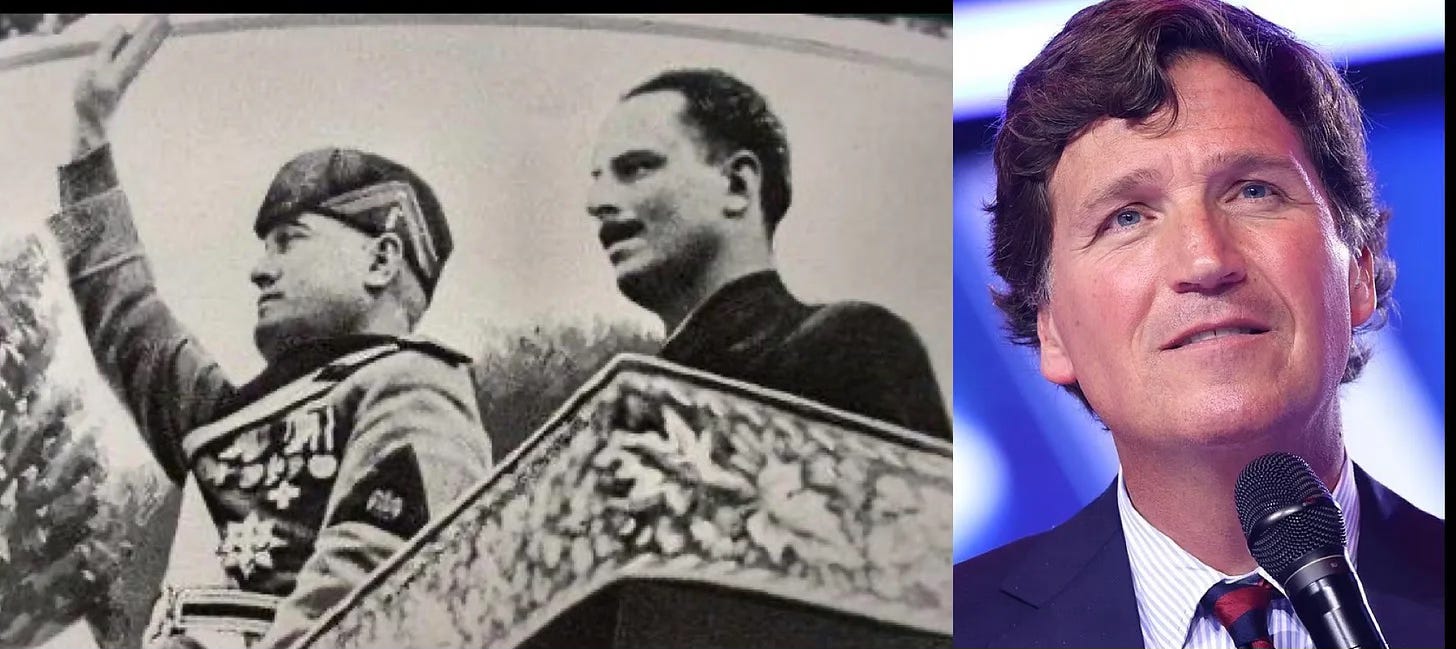
There are moments when rhetoric stops being careless, stops being provocative, and becomes something else entirely—something revealing.
Tucker Carlson has crossed that line.
For years, Carlson has chipped away at the historical consensus surrounding the Second World War. He has questioned Winston Churchill’s role, amplified fringe revisionists, and suggested that the moral clarity of that conflict is overstated. That alone was troubling.
But his latest comments go far beyond historical revisionism.
They amount to the rehabilitation of fascism.
On his podcast, Carlson described Oswald Mosley—the leader of British fascists during the 1930s and early years of the Second World War—as one of Britain’s “great war heroes.” He claimed Mosley’s only offense was opposing Churchill, and suggested that his wartime internment as a security threat under an emergency act was simply the suppression of legitimate political dissent.
This is grotesque historical revisionism.
Mosley was not a misunderstood patriot. He was not the leader of a legitimate opposition party. He was the founder of the British Union of Fascists, a marginal movement that never gained democratic traction and never won a seat in Parliament.
What Mosley did succeed in doing was something far more dangerous.
He imported fascism into Britain.
He built a movement modeled explicitly on Mussolini’s Italy and Hitler’s Germany. He cultivated paramilitary intimidation through his Blackshirt followers. His rallies were marked by violence. His marches were deliberately routed through Jewish neighborhoods—not by accident, but by design. He trafficked in conspiracy theories about Jews controlling finance, media, and politics—ideas that were not merely fringe, but central to his movement.
This was not abstract ideology. Mosley’s movement translated into real fear, violence, and hatred.
I know this not as a historian, but as someone who lived in its aftermath.
I grew up in London in the 1950s and 1960s, in a Britain that had defeated Hitler but had not fully defeated the ideas that Mosley helped normalize. The war was over. The uniforms were gone. But the hostility lingered—in classrooms, in playgrounds, in the everyday lives of Jewish families.
The insults were constant. “Dirty Jew.” “Go back to where you came from.” Complaints that Hitler had not finished the job.
At school after school—more than a dozen by the time I was sixteen—the pattern was the same. Swastikas carved into desks. Taunts whispered and shouted. Violence that was casual and routine.
This was not ancient history. It was not theoretical. It was the residue of a movement that had made antisemitism visible, acceptable, and, for some, respectable.
Mosley did not invent antisemitism in Britain. But he amplified it, organized it, and gave it a political structure.
That matters. And it is why Carlson’s comments are not just historically inaccurate—they are morally indefensible.
Carlson suggests that Mosley was punished merely for opposing Churchill. In reality, Mosley was detained under wartime emergency powers——Defence Regulation 18B—because he was aligned with Britain’s enemies. He had cultivated relationships with fascist leaders across Europe. He married British fascist aristocrat, Diana Mitford, at the Berlin home of Nazi propaganda miinster Joseph Goebbels—with Hitler in attendance.
This was not dissent. This was ideological alignment with regimes Britain was fighting for its survival against.
Carlson also paints Churchill as a tyrant who imprisoned political opposition. This is equally misleading. Britain, in its darkest hour, formed a coalition government that included major political rivals. Churchill governed alongside Labour leadership, including Clement Attlee as deputy prime minister.
The idea that Britain suppressed legitimate opposition is fiction. The reality is that Britain isolated a small number of fascist sympathizers during a moment of existential threat.
That distinction is fundamental.
So why does this matter now?
Because most people outside of the UK do not know who Oswald Mosley was. To them, this may sound like an obscure historical debate.
It is not.
To those who do know, Carlson’s comments are shocking because they follow a pattern: the inversion of moral responsibility, the recasting of aggressors as victims, and the steady erosion of the line between democratic dissent and authoritarian ideology.
When you portray a Nazi-aligned fascist as a persecuted patriot, you are not engaging in historical nuance. It is rewriting the moral framework of the twentieth century.
And when you do that, you are not just talking about the past but instead are reshaping how people understand the present.
There is a reason Mosley’s name still carries weight in Britain, particularly among Jews of my generation. It is not because of what he achieved politically. It is because of what he unleashed socially.
And once unleashed, that kind of hatred does not disappear simply because a war is won. It lingered and mutated.
Growing up in that atmosphere I learned that silence and appeasement do not stop hatred. They invite it.
That lesson feels uncomfortably relevant again.
Carlson’s embrace of Mosley is not an isolated misstatement. It is a signal. It tells us something clear about how far the boundaries of acceptable discourse have shifted—and how willing some are to normalize ideas that were once universally understood as beyond the pale.
Rehabilitating figures like Mosley is not about revisiting history.
It is about testing whether we have learned anything from it.
I think he revealed exactly who he is. There's no dishonesty or misconception of who he aligns himself with. I find it disgusting. Thank you for putting it on paper and disclosing it to us all to read.
⭐️⭐️⭐️⭐️⭐️@trishaposner your very clear first person account in response to Carlson who at a minimum is a revisionist and most a liar. He’s turning into David Irving!
Oswald Mosley is a disgusting Nazi sympathizer and proud fascist who personally knew Hitler. He modeled his part after the European fascist dictatorships and was sympathizer, collaborator, and sympathizer, collaborator, and ideological fellow-traveler who sought alliances with Hitler and whose movement adopted key Nazi traits - especially racial antisemitism and authoritarian corporatism.